
Berks County seat since 1752
Epoxy Flooring in Reading, PA
Basement, garage and shop floors for a city of brick rowhouses, river wards and old industrial buildings.
- Free on-site estimate with a slab moisture check
- Written quote listing prep, repairs and every coat
- Mechanical grinding and crack repair before coating
Reading Floors, Block by Block
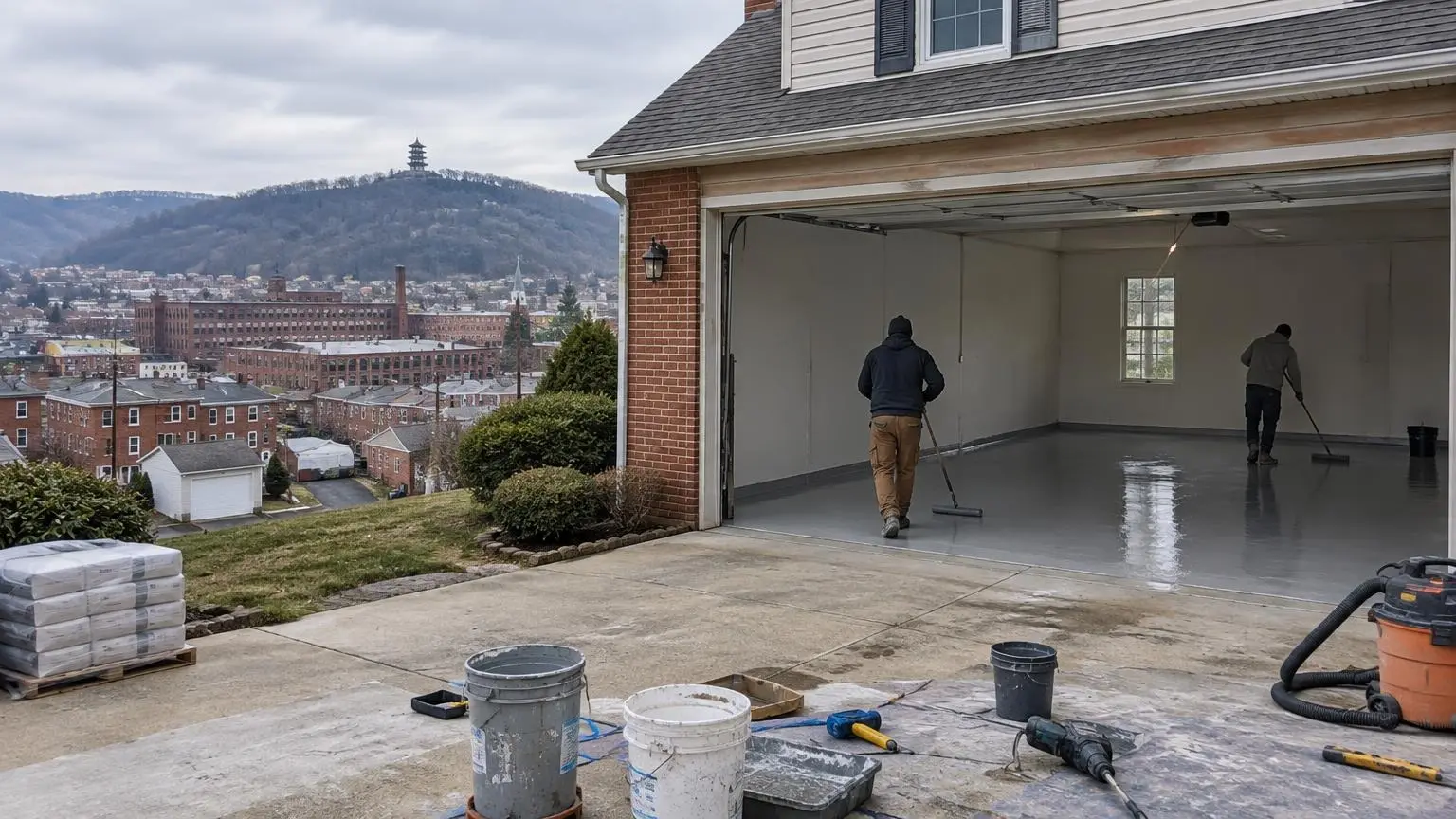
Epoxy flooring in Reading is mostly a basement and alley-garage business, because that is what the city is built from. Census estimates for 2019 to 2023, reported by Point2Homes, count 18,824 single-family attached homes in Reading, against 4,256 detached ones. Only 1.6% of the housing went up between 2000 and 2009, and 1.4% between 2010 and 2019. Most of the concrete we coat here was poured generations ago. We plan every job around that.
A city that peaked early
Reading was laid out in 1743 by Richard and Thomas Penn with Conrad Weiser, became a borough in 1783 and a city in 1847. Its population reached nearly 120,000 in the 1930s and then fell sharply from the 1940s to the 1970s. That history explains the floors. The houses went up during the boom, and few replaced them during the decline. A slab under a Centre Park or Queen Anne Historic District home may have had a coal bin, an oil tank, a laundry tub and a workbench on it over the last century.
What that means for the basement
An old basement slab is often thin, uneven and patched in several mixes. We usually find some of these:
- Floor paint in several layers, some of it peeling
- Black adhesive from tile laid in the 1950s or 1960s
- Saw-cut trenches where a drain or water line was replaced
- A low spot by the floor drain where water has stood
- Hairline cracks along the walls and around old column footings
All of it comes off or gets filled before we coat. Paint and adhesive are ground away. Trenches and low spots are patched to the surrounding level. Then we test the bare concrete for moisture, because a coating can only bond to a slab that is dry enough.
The river wards
The Schuylkill River runs along the city's west side, and the lower precincts near it have flooded again and again. Hurricane Agnes caused extensive flooding in 1972, and a smaller flood followed in June 2006. If your basement has taken water, tell us when you call. A slab that has flooded can hold moisture for a long time, and some of these floors also sit close to the water table. We use a moisture-tolerant primer where the readings call for it. If water is still coming through the walls or floor, a coating will not stop it, and we will say so before you pay for one.
Alley garages
Many Reading blocks have a rear alley with small garages along it. These are usually one-car buildings with a slab that slopes to the door and takes the full weight of winter. January lows average 23°F at Reading Regional Airport, and road salt comes in on every tire. We grind these floors, fill the pitting near the door, and finish them with a flake system and a clear topcoat that wipes clean. For a garage used as a shop or storage room, a solid color with a light texture works too.
Rentals and multi-unit buildings
About 59.4% of Reading's occupied homes are rented, according to the same Census estimates. Many owners hold a twin, a converted rowhouse or a small building with a shared basement. For those floors we keep it practical:
- A sealed, light-colored basement floor that shows dirt and is easy to mop
- Coated laundry and utility areas where water and detergent spill
- Garage floors that do not soak up a former tenant's oil
- Scheduling between leases, with cure times written down
A coated basement does not make a damp room dry, and it does not replace a working sump or gutter. It does make the floor easier to clean and inspect between tenants.
Old commercial and mill floors
Reading built railcars, iron, beer, hosiery and early automobiles. The Reading Railroad carried anthracite to the Port of Philadelphia, the Reading Brewing Company ran from 1886 to 1976, and the former Willson Goggle Factory, now GoggleWorks, joined the National Register in 2006. Old industrial and storefront buildings around the city now hold shops, studios, restaurants and offices. Their floors can be thick, worn and stained with a century of use. We grind them, repair the joints and spalls, and install a commercial system sized for the traffic the space gets now.
Neighborhoods we hear from
The city's neighborhood list runs from Center City and Callowhill to Centre Park, Glenside, Millmont, the Outlet District, Hampden Heights and Southside. The floors differ by street more than by name. A Centre Park twin may have a tall, dry basement under a house with ornate brick. A block near the river may have a low, damp one. A house near the base of Mount Penn may have a basement that takes groundwater from the slope after heavy rain. We do not assume. We look, test and then quote.
What a coated basement is good for
Owners in Reading use a coated basement for storage that stays clean, a laundry room that mops easily, a workshop, a home gym or a playroom. A coating also makes the floor bright, so the space feels less like a cellar. If you plan to finish the walls or add carpet tiles later, tell us. We can choose a coating that works under rugs and furniture, and we can coat around a furnace, water heater or oil tank without moving it.
Picking a season
The last killing frost usually comes in early to mid April, and the first arrives in late October. Garages are easiest to coat between those dates. Summer brings about 27 days above 90°F, and humidity can make a cool basement slab sweat. We read the slab and air temperatures on the day of the install and adjust the products or the schedule to match. Basements stay at a steadier temperature, so we coat them all year.
What to Know About Reading's Housing and Ground
- Mostly attached homes. Census estimates for 2019 to 2023 count 18,824 single-family attached homes in Reading (52.2%) and 4,256 detached homes (11.8%), per Point2Homes.
- Very little new construction. Only 1.6% of Reading's housing was built from 2000 to 2009 and 1.4% from 2010 to 2019, so most basement and garage slabs are decades old.
- A renter-majority city. About 59.4% of occupied units in Reading are renter-occupied and 40.6% are owner-occupied (ACS 2019 to 2023 via Point2Homes).
- Flood history on the Schuylkill. The lower precincts along the Schuylkill River are repeatedly inundated. Hurricane Agnes flooded the city in 1972, and a smaller flood hit in June 2006.
Reading Questions
Can you coat a Reading rowhouse basement that has old paint and tile glue on it?
Yes, in most cases. We grind off the paint and the black adhesive down to bare concrete, patch trenches and low spots, and test the slab for moisture before any coating goes down. If the floor is crumbling or water is actively coming in, we tell you what has to be fixed first.
My basement flooded in the past. Can it still get epoxy?
Often it can. We take moisture readings across the slab. If they are within range, we use a moisture-tolerant primer under the coating. If the slab is still wet or water keeps coming in, we will recommend dealing with the water before coating so the floor does not blister.
Do you coat floors in rental properties between tenants?
Yes. Many Reading owners have us coat basements, laundry areas and garages between leases. We give you a written schedule with walk-on and move-in times so you can plan the turnover.
Free Estimates in Reading, PA
Free estimates for Reading rowhouses, twins, rentals and storefronts.
Epoxy Flooring Near Reading
- Epoxy Flooring in Wyomissing, PA
- Epoxy Flooring in West Reading, PA
- Epoxy Flooring in Shillington, PA
- Epoxy Flooring in Sinking Spring, PA
- Epoxy Flooring in Spring Township, PA
- Epoxy Flooring in Exeter Township, PA
- Epoxy Flooring in Muhlenberg Township, PA
- Epoxy Flooring in Cumru Township, PA
- Epoxy Flooring in Mount Penn, PA
- Epoxy Flooring in Kenhorst, PA
- Epoxy Flooring in Mohnton, PA
- Epoxy Flooring in Laureldale, PA
- Epoxy Flooring in Bern Township, PA
- Epoxy Flooring in Wernersville, PA
- Epoxy Flooring in Robesonia, PA
- Epoxy Flooring in Birdsboro, PA
- Epoxy Flooring in Amity Township, PA
- Epoxy Flooring in Boyertown, PA
- Epoxy Flooring in Fleetwood, PA
- Epoxy Flooring in Kutztown, PA
- Epoxy Flooring in Maidencreek Township, PA
- Epoxy Flooring in Leesport, PA
- Epoxy Flooring in Hamburg, PA